
The 500 Syrian Pounds banknote (500 Syrian Lira) from the late 20th century is widely admired by collectors, historians, and numismatists as one of the most beautiful banknotes ever made. Long before modern minimalist currency trends, this note stood as a bold artistic statement—rich in symbolism, deep historical meaning, and exceptional engraving quality. Among collectors of world banknotes, Middle Eastern currency, rare paper money, and artistic banknote design, the classic Syrian 500 Lira occupies a near-mythical status, often praised in collector forums and numismatic literature as a true work of art rather than merely legal tender.
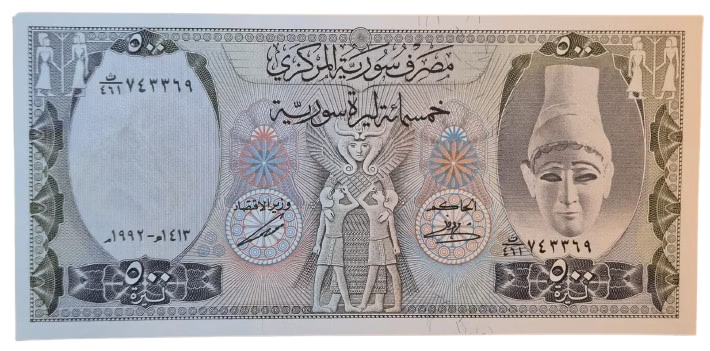
Issued by the Central Bank of Syria and circulating prominently from the 1970s through the early 1990s, this older 500-pound note represents a period when banknotes were designed to narrate national identity through ancient heritage. Many collectors consistently rank it among the most visually stunning banknotes of the 20th century, alongside famous issues from Switzerland, France, and Japan, citing its balance, symmetry, and storytelling imagery.
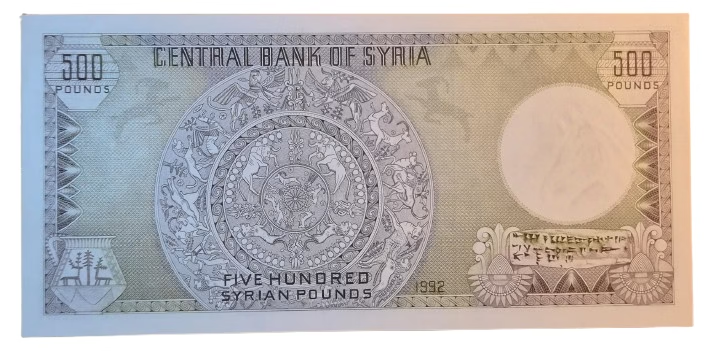
The older 500 Syrian Pounds banknote was introduced at a time when Syria sought to emphasize its role as one of the world’s oldest cradles of civilization. Rather than showcasing modern political figures or infrastructure, the design deliberately turned backward in time—toward archaeology, mythology, and the origins of human culture.
Printed using advanced intaglio techniques for its era, the note reflects exceptional craftsmanship. The engraving depth, line work, and ornamental patterns reveal a level of artistic investment rarely seen in modern banknotes. This approach aligned with a broader mid-20th-century philosophy in banknote design, where currency served as a cultural ambassador as much as an economic tool.
Over time, as newer designs replaced it, this classic 500 Lira note quietly transitioned from circulation into the hands of collectors, where its true value—as an object of beauty and history—became fully appreciated.
What truly elevates the older 500 Syrian Pounds banknote is the richness of its symbols, each carefully chosen to reflect Syria’s ancient legacy.
At the center of the obverse, the note features figures inspired by ancient Near Eastern deities, believed to reference the archaeological heritage of Ugarit, one of the most significant ancient cities in the Levant. Ugarit is famed for its early alphabetic writing system, and its influence on language, religion, and trade across the Mediterranean world. The mirrored figures suggest balance, continuity, and the duality found in ancient belief systems.
Flanking these figures are elaborate geometric and rosette patterns, echoing motifs found in ancient mosaics, temples, and ceremonial objects. These designs are not decorative alone—they symbolize eternity, order, and the cyclical nature of civilization.
On the right side of the note appears a stylized ancient sculpted head, inspired by archaeological discoveries from Syrian soil. This image represents identity, memory, and the endurance of culture across millennia. Rather than glorifying individuals, the design glorifies civilization itself.
The reverse side continues this narrative with ornamental circular compositions, often interpreted by collectors as references to ancient shields, ceremonial plates, or cosmic symbolism common in Near Eastern art. The English inscription “FIVE HUNDRED SYRIAN POUNDS” is discreetly placed, allowing the artwork to dominate rather than the denomination.
Beyond aesthetics, the classic 500 Syrian Pounds note incorporated sophisticated security features for its time, including detailed watermarks and complex line structures that made counterfeiting difficult. The muted yet harmonious color palette—earthy greens, grays, and soft blues—was intentionally chosen to evoke antiquity rather than modernity.
Collectors often remark that the note feels more like a museum engraving than a banknote, a quality that significantly contributes to its reputation as one of the most beautiful banknotes ever issued.
Among collectors of rare banknotes, vintage Middle Eastern currency, and artistic paper money, the older Syrian 500 Lira is frequently singled out as exceptional. Numismatic discussions, collector rankings, and auction descriptions often describe it as “timeless,” “hauntingly beautiful,” and “a masterpiece of currency art.”
Its appeal lies not only in visual beauty but in intention—the deliberate decision to honor ancient civilization rather than contemporary power. This philosophical depth, combined with outstanding engraving quality, places the note in a league of its own.
Today, well-preserved examples of this classic banknote are increasingly sought after, not merely as collectibles, but as cultural artifacts—silent storytellers of a land that shaped human history itself.