By: Ahmad Saed Alzein
CEO of House of Emirates
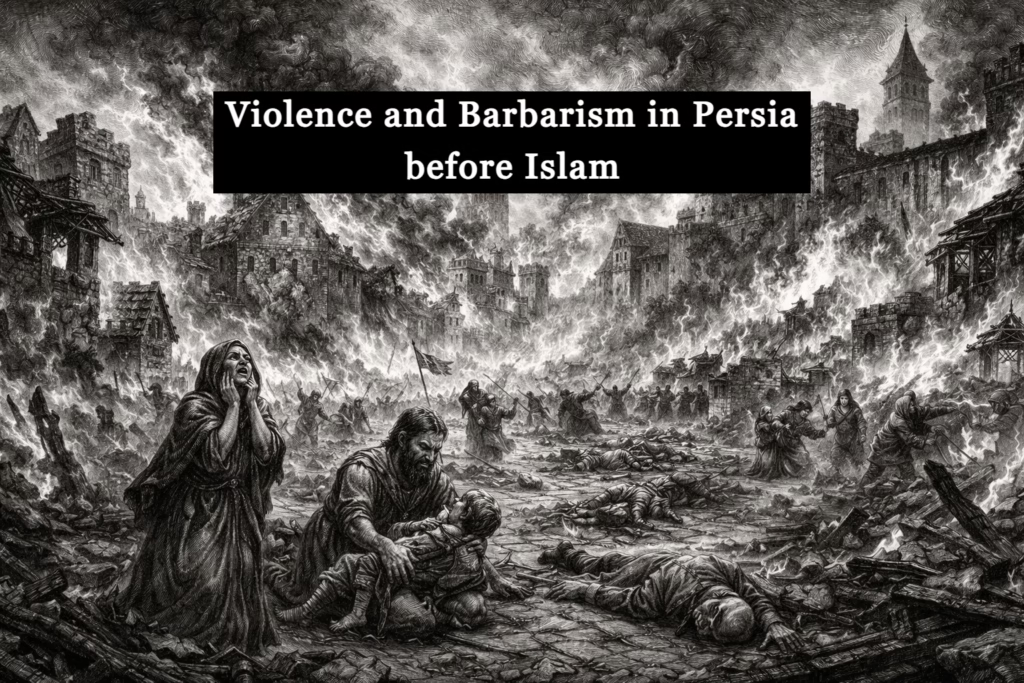
I reject the modern narrative that portrays pre-Islamic Persia as a land of uninterrupted peace, enlightenment, and prosperity, only to suggest that chaos and decline began with the arrival of Islam. This claim is not merely inaccurate; it is intellectually outrageous and morally dishonest. It insults Muslims and anyone genuinely committed to historical truth by implying that Islam was a civilizational rupture, rather than a response to a world already shaped by violence, instability, and blood-soaked imperial rule.
History does not support this fantasy, and repetition does not turn falsehood into fact.
What troubles me is not pride in heritage. Every civilization has the right to honour its past. The problem begins when pride mutates into deliberate amnesia—when documented barbarism is erased to construct a modern cultural grievance. Pre-Islamic Persia was not a utopia shattered by faith. It was a vast empire sustained by looting, destruction, mass executions, scorched cities, and perpetual war. To deny this is to erase the suffering of millions who lived and died under persian violence long before Islam ever reached Persian lands. This is not provocation for its own sake. It is correction—stripping away romantic mythology and replacing it with historical reality, however uncomfortable that reality may be.
The idealized image of ancient Persia collapses the moment its political record is examined without nostalgia or nationalist myth-making. Long before Islam, Persian empires were forged and preserved through ruthless force. Dynastic murder was not an aberration; it was a mechanism of survival. The Achaemenid dynasty itself—so often praised today as tolerant and enlightened—was born in blood and ruled through extreme fear. Cambyses II, son of Cyrus the Great, murdered his own brother Bardiya to secure the throne, then descended into paranoia and cruelty. His campaigns in Egypt were marked by mass executions and the desecration of sacred buildings, as recorded by classical sources. This was not enlightened governance; it was persian terror.
Xerxes I, often romanticized in popular imagination, razed Athens to the ground and ruled through intimidation. He did not die peacefully; he was assassinated in a palace coup led by his own commander, Artabanus.
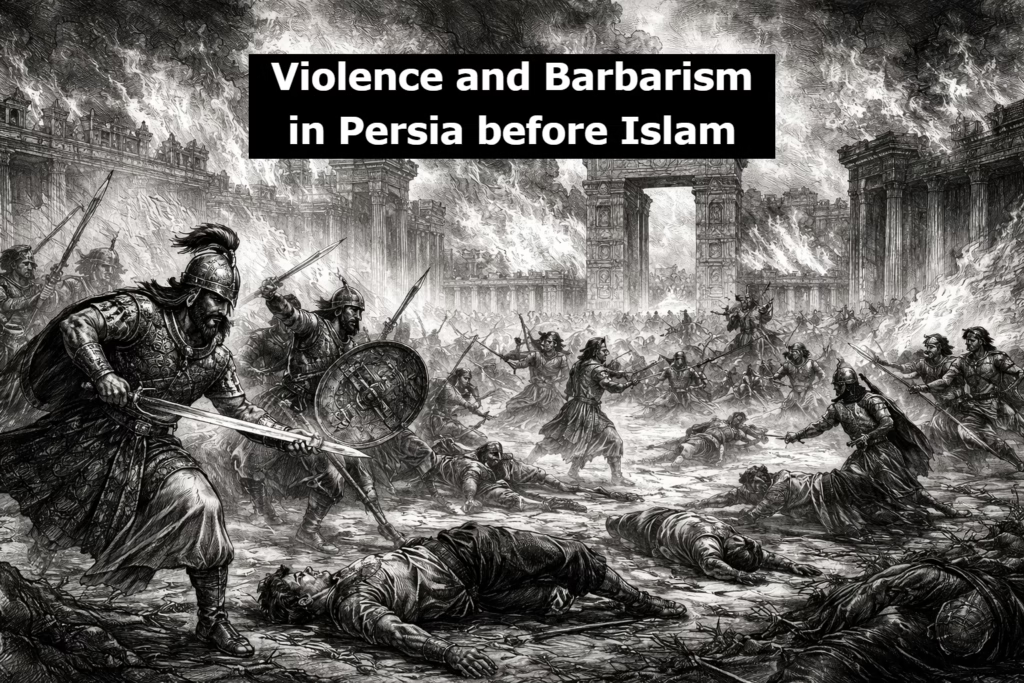
Artaxerxes III Ochus took paranoia to its logical extreme, exterminating entire branches of the royal family—poisoning and executing brothers, nephews, and court elites to eliminate rivals. These were not isolated excesses. They were structural features of Persian imperial rule, where legitimacy rested on force and survival depended on eliminating one’s own kin faster than they could strike first. Any claim that pre-Islamic Persia was governed by moral harmony ignores a basic fact: regicide and fratricide were routine instruments of statecraft.
This pattern did not soften with time. Under the Parthians and later the Sasanians, it intensified. The Arsacid dynasty functioned like a permanent civil war disguised as monarchy—brothers murdering brothers, sons overthrowing fathers, kings ruling amid constant rebellion and betrayal. The Sasanian era, often presented as the pinnacle of Persian identity, was particularly brutal. Shapur I deported entire populations after sacking Roman cities such as Antioch, forcibly relocating tens of thousands to serve imperial projects—demographic engineering through terror.
Shapur II earned the title “the Great” through campaigns that annihilated Arab and Roman settlements alike, leaving scorched landscapes behind him. Even rulers later praised as just were capable of extreme cruelty. Khosrow I Anushirvan ordered the mass slaughter of the Mazdakites—men, women, and children—burying them alive or hanging them upside down to eradicate a social movement he deemed threatening. His grandson, Khosrow II, represents the moral collapse of a system built on blood. Overthrown, imprisoned, and executed by his own son, Kavadh II then murdered nearly all his brothers in a single purge, crippling the empire’s leadership in one night. This was not degeneration at the end of an otherwise peaceful tradition. It was the inevitable outcome of centuries of normalized internal violence.
Beyond their borders, Persian armies demonstrated repeatedly that empire was built through annihilation, not coexistence. Cities were burned, populations uprooted, and economies deliberately shattered. From the destruction of Ionia during the Greco-Persian wars to the repeated sackings of Roman cities in Mesopotamia and Syria, exemplary punishment was policy. Regions were emptied through forced migrations; rebellious cities were erased as warnings to others. Even the much-celebrated religious tolerance of ancient Persia was conditional and reversible. Under rulers such as Yazdegerd II and later Sasanian kings, persecution followed the moment political loyalty was questioned.
This is the world Islam entered. And this is the point modern revisionists refuse to confront. Islam did not arrive in Persia to destroy a peaceful civilization. It arrived in a land exhausted by persian brutality, dynastic bloodshed, and moral bankruptcy. And instead of erasing Persia, Islam transformed it. What followed was not cultural extinction, but civilizational elevation.
Within a few generations, Persian Muslims became central architects of one of the greatest intellectual civilizations in human history. Persia did not vanish under Islam; it re-emerged—no longer defined by imperial terror, but by knowledge, ethics, and contribution to humanity. The Arabic language became the medium of scholarship, but the Persian mind was often behind the ideas. Science, medicine, mathematics, astronomy, philosophy, literature, and governance flourished—not in spite of Islam, but because of it.
Abu Bakr al-Razi revolutionized medicine through empirical observation, distinguishing smallpox from measles and insisting on evidence over superstition. Ibn Sina produced The Canon of Medicine, a work that dominated medical education in both the Islamic world and Europe for centuries. Al-Khwarizmi gave the world algebra and algorithms—concepts foundational to modern science and computing. Al-Biruni calculated the Earth’s radius with astonishing accuracy and approached other cultures with intellectual rigor rather than imperial contempt. Nasir al-Din al-Tusi transformed trigonometry and astronomy, influencing later European thinkers. Persian Muslims reshaped literature and ethics as well. Ferdowsi preserved Persian language and identity through The Shahnameh within an Islamic civilization confident enough to allow cultural memory without bloodshed. Omar Khayyam blended mathematics, astronomy, and poetry in works that still speak to the human condition. This was a civilization capable of inquiry, doubt, beauty, and reflection—qualities empires of fear rarely tolerate.
Most importantly, Islam challenged the old Persian model of legitimacy through blood. It introduced moral accountability, legal constraints on power, and the principle that rulers were subject to law rather than above it. Knowledge became an act of worship. Scholarship became a path to honor. Social mobility expanded beyond noble bloodlines, allowing talent to rise where birth once dictated fate.
So when people claim that Islam “destroyed” Persia, they are not defending history—they are denying it. What Islam ended was not Persian civilization, but Persian imperial barbarism. What it elevated was Persian intellect, creativity, and contribution to humanity. The Persia that shaped the world—the Persia of science, medicine, philosophy, and poetry—was not pre-Islamic. It was Muslim.
This is not an attack on Persian identity. It is a defence of truth. And the truth is simple: Islam did not plunge Persia into darkness. It helped bring Persia out of it.